
ISO 14001:2026 was published in April 2026 and replaces the 2015 edition, including the 2024 climate change amendment. If your organisation is certified, or working towards certification, it is worth understanding what has changed and what it means for how you manage energy in your buildings.
How big is the ISO 14001:2026 change?
Certification bodies such as DNV describe the revision as moderate. The aim was to clarify existing requirements rather than introduce many new ones, and to align the standard with the latest ISO Harmonized Structure so it fits more easily with other management system standards.
What has changed
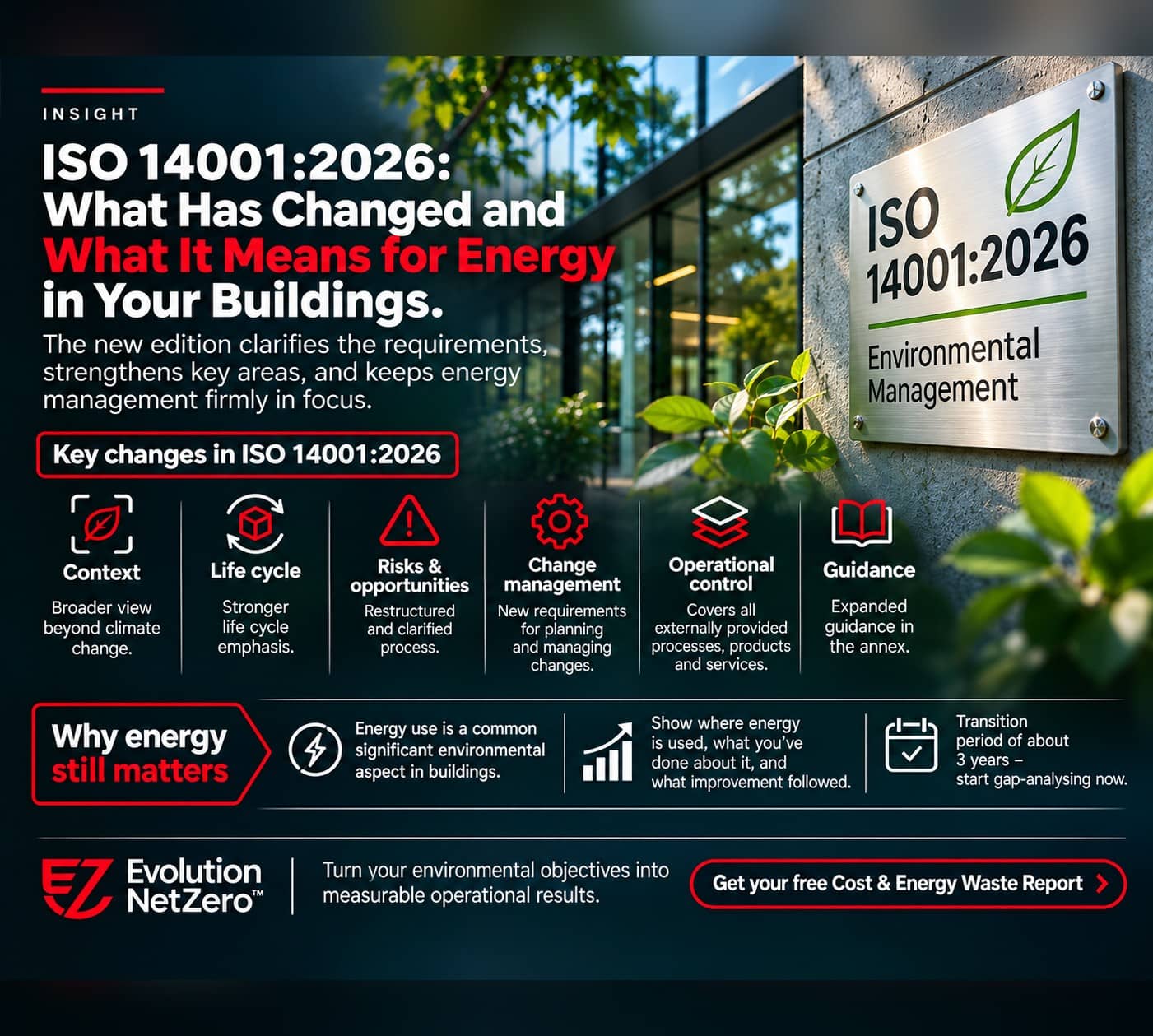
- Context: the analysis of your organisation’s context now looks beyond climate change to other conditions such as pollution, biodiversity and the availability of natural resources.
- Life cycle: a stronger emphasis on a life cycle view when you identify environmental aspects.
- Risks and opportunities: the process has been restructured and clarified.
- Change management: new requirements for planning and managing changes.
- Operational control: control extends from outsourced processes to all externally provided processes, products and services.
- Guidance: the guidance in the annex has been expanded.
ISO 14001:2026 transition timeline
Certificates issued to ISO 14001:2015 remain valid during a transition period of about three years. Certified organisations will need to move to the new edition before the end of that period, so the practical advice is to start gap-analysing now rather than in the final year. Check the exact date with your certification body.
Why energy still matters
Energy use is one of the most common significant environmental aspects in buildings. Whatever your objectives say, you will need to show how you identify where energy is used, what you have decided to do about it, and what improvement followed.
Setting an objective such as “reduce energy consumption” is easy. Knowing where energy is being wasted, what deserves attention first, what is financially viable and how you will demonstrate the improvement afterwards is much harder. That is where good data helps.
ISO 14001 and ESOS are not the same thing
A common question is whether ISO 14001 satisfies ESOS. On its own it does not: it is not one of the compliance routes in the government guidance. ISO 50001 can be, if the certificate covers your significant energy use and meets the date requirements. Our guide to ESOS compliance routes and ISO 50001 explains the difference.
A better starting question
Before asking “what technology should we install?”, ask: where are our biggest opportunities for measurable improvement, and what is doing nothing currently costing us?
Get clarity first, then decide what deserves investment. If your environmental objectives need to translate into measurable operational results, see how we support ISO 14001 and 50001 certification, or start with a free Cost & Energy Waste Report.
Leave a Reply