
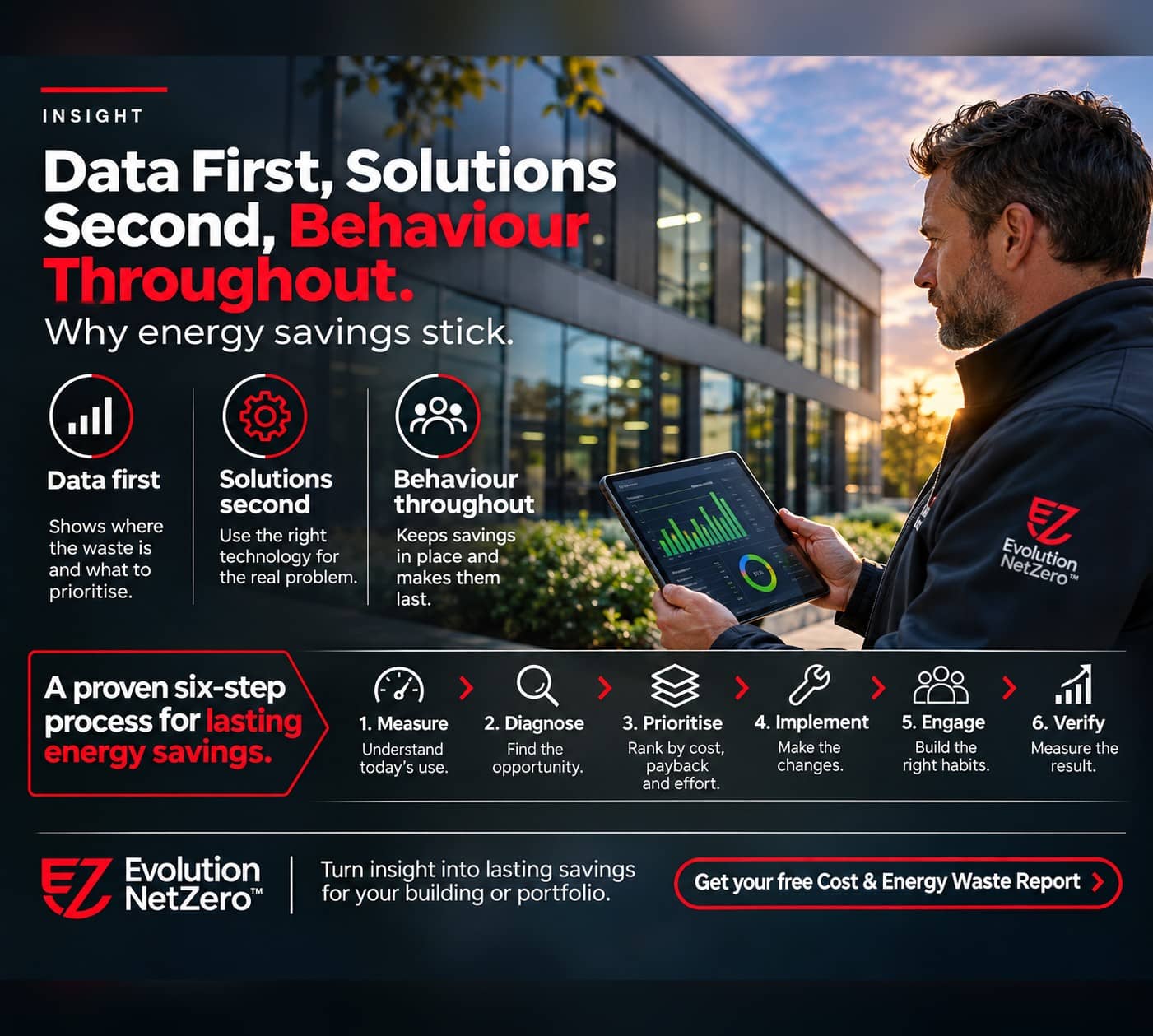
Lasting energy savings rarely start with the solution. Too often the conversation begins there: solar, controls, HVAC, monitoring, optimisation.
A better starting point is simpler: where is the energy actually being wasted?
Data first
Data shows where the waste is. Without it, decisions rest on assumptions, and the biggest line on the bill is not always the biggest opportunity. Good data lets you rank opportunities by cost and payback, and gives you a baseline to measure against later. The same baseline underpins ESOS assessments for larger organisations.
That data does not have to be perfect to be useful. Half-hourly meter readings, monthly bills, opening hours and occupancy are usually enough to show a pattern, and a pattern is enough to ask the right questions.
Solutions second
Technology can then help fix what the data has found. Heating optimisation, smarter HVAC and guestroom controls, better monitoring, changes to hot-water demand. The right solution depends on the building. It is chosen after the diagnosis, not before.
This is also what keeps advice grounded in your building. When the starting point is the data, the answer can be “change a setting” or “do nothing yet” as easily as “buy this”.
Behaviour throughout: how savings last
Even the best system can be undermined by poor settings, unnecessary run times, doors left open or equipment left on. Small operational changes and everyday habits can unlock real savings when they are paired with the right data.
That is why behaviour matters from the first day, not as an afterthought. Teams who can see how a building uses energy make better decisions, and those habits often travel home with them too.
A process that delivers lasting energy savings
Our approach follows six steps:
- Measure: establish how the building uses energy today.
- Diagnose: find where use is higher than it should be, and why.
- Prioritise: rank opportunities by cost, payback and effort.
- Implement: make the changes, starting with the cheapest.
- Engage: make sure the people running the building understand and keep the change.
- Verify: measure the result against the baseline.
Engage sits in the middle on purpose. It is the step that turns a one-off saving into a lasting one.
Lasting energy savings can come from the smallest project
Not every saving needs a capital project. Sometimes it starts with better information and one small change in how a building is run. Behaviour is where energy strategy becomes culture.
To see how this could work for your property, read about our commercial energy audit or remote energy assessment, or start with a free Cost & Energy Waste Report.
Leave a Reply